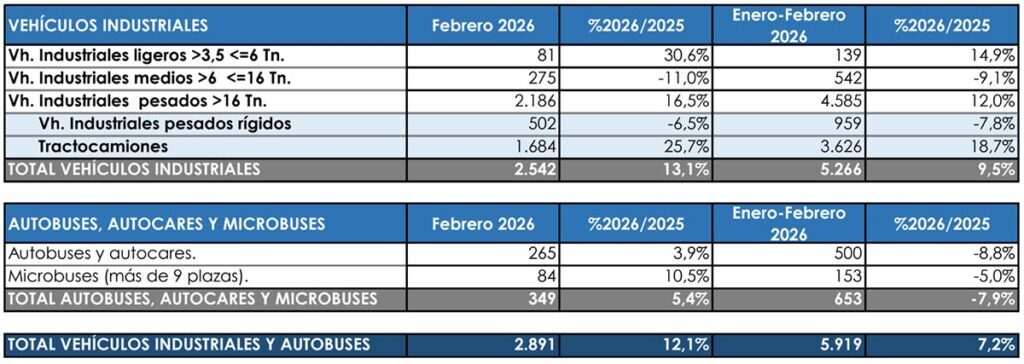
The commercial vehicle market in Spain maintains a positive trend at the start of 2026. During February, 2.542 trucks were registered , representing a 13,1% increase compared to the same month of the previous year . This data reflects a progressive fleet renewal by transport companies and logistics operators, consolidating the sector's dynamism after the strong results recorded in the second half of 2025.
This growth confirms the positive state of professional road transport and anticipates a year marked by investment in efficiency, safety and modernization of the industrial vehicle fleet.

Sustained growth of the truck market
The market momentum in February is mainly supported by the tractor unit segment , which continues to be the engine of growth within the heavy commercial vehicle sector.
Tractor unit registrations increased by 25,7% in February , accumulating an 18,7% rise in the first two months of the year . This trend is directly related to the need for many transport companies to renew their fleets to improve efficiency, fuel consumption, and operational availability.
However, the evolution has not been homogeneous in all segments.
Rigid trucks experienced a 6,5% decline in February and have accumulated a 7,8% drop so far this year , reflecting greater caution in certain distribution and service sectors.
Mixed results in light and medium industrial vehicles
Within the industrial vehicle group, the results also show different behaviors depending on the type of vehicle.
Light commercial vehicles continue to show positive growth, registering a 14,9% increase year-to-date , driven mainly by urban distribution and last-mile logistics activities.
Conversely, medium-sized industrial companies show a drop of 9,1% , demonstrating a more cautious context in this segment.
Despite these differences, the overall market balance confirms a trend of moderate but sustained growth at the beginning of 2026.
The total market for industrial vehicles exceeds 2.800 units.
If trucks, buses, coaches and minibuses are analyzed together , the total volume of registrations reached 2.891 units in February , representing a year-on-year growth of 12,1%.
In the case of the bus and coach segment, the market is beginning to experience a readjustment process after the excellent results obtained in 2024 and 2025.
Industry forecasts indicate that sales during 2026 will be around 3.700 to 3.800 units , a figure lower than the 4.400 registrations recorded last year.
Light commercial vehicles are also growing
The light commercial vehicle segment also registered positive performance in February.
During that month, 15.754 units were registered , representing an increase of 12,7% compared to the same period of the previous year.
In the first two months of 2026, registrations reached 28.938 units , with a growth of 8,9%.
Businesses and the self-employed are driving demand
Channel analysis reveals that the growth of the light commercial vehicle market is being driven primarily by businesses and professionals.
- Freelancers: 3.009 units registered (+17,5%)
- Business: 10.625 units (+7,3%)
- Landlords: 2.120 units (+40%)
Particularly significant is the increase recorded by rental companies, which show the highest percentage growth.
A sector undergoing technological renewal
The positive evolution of the commercial vehicle market reflects a clear trend towards fleet modernization and improved operational efficiency . Transport companies continue to invest in more efficient, safer vehicles that meet new regulatory requirements.
This renewal process not only affects vehicles, but also the entire aftermarket ecosystem for commercial vehicles, where the availability of spare parts, specialized technical assistance and logistical speed have become key factors to guarantee the operability of fleets.
For distributors and spare parts professionals, this scenario represents an opportunity to reinforce their role as strategic partners of professional transport , accompanying the technological evolution of the sector.
Source: Autopos