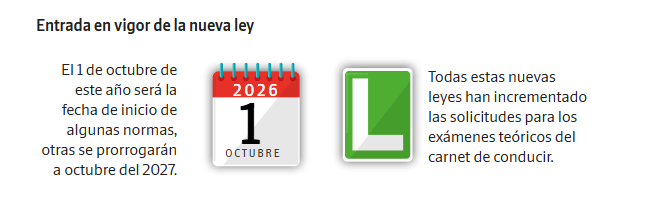
On October 1, 2026, a significant amendment to the General Traffic Regulations will come into effect. Electric scooters, cyclists, motorcyclists, and other drivers will have to comply with new regulations regarding helmets, visibility, overtaking, protective equipment, and emergency driving.
Royal Decree 518/2026, of June 24 , amends the General Traffic Regulations with the aim of strengthening the protection of so-called vulnerable road users , a category that includes, among others, pedestrians, cyclists, users of personal mobility vehicles (PMVs), and users of motorcycles and mopeds. The regulation enters into force generally on October 1, 2026. ( Official State Gazette )
The reform introduces important changes that you should be aware of before hitting the road.
Electric scooters: minimum age, helmet and greater visibility
Users of personal mobility vehicles, such as electric scooters , are one of the groups most affected by the new regulations.
From October 1st:
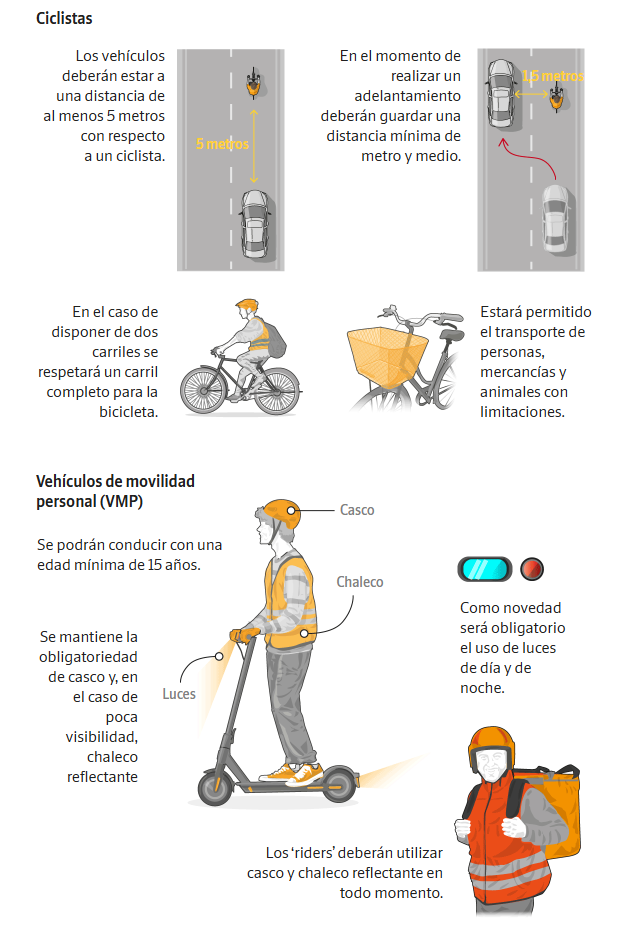
- La The minimum age to drive a VMP will be 15 years old.
- It will be mandatory to use protection helmet.
- During the night or in conditions of poor visibility, the required reflective elements must be used.
- Professionals who carry out their activity using a VMP (Personal Mobility Vehicle) must use the protective and high visibility equipment established during their workday.
- Drivers must signal maneuvers using their arm.
Failure to comply with certain obligations relating to the helmet and protective equipment may constitute a serious offense punishable by a fine of 200 euros.
When will it become mandatory to have scooter lights on?
There is a particularly important nuance here.
The new regulations stipulate that personal mobility vehicles (PMVs) must have their lights switched on. However, there is a transitional period for their use during the day : this daytime requirement will come into effect one year after the Royal Decree enters into force, that is, from October 1, 2027. ( BOE)
Therefore, it should not be interpreted that the entire lighting obligation is delayed until 2027.
Bicycles: mandatory helmet and new overtaking rules
Cyclists will also have greater protection from October 1st.
One of the main changes is the elimination of certain exceptions that allowed cyclists to ride without a helmet on intercity roads. With the new regulations, helmets will be mandatory for cyclists on intercity roads . (BOE)
In addition, professionals who work while traveling by bicycle must also use the protective equipment provided during their professional activity.
Overtaking rules for cyclists change
The reform tightens the conditions for overtaking a bicycle on the road.
On intercity roads, the vehicle performing the overtaking maneuver must:
- Reduce your speed in at least 20 km/h with respect to the maximum speed limit of the road.
- Maintain the appropriate lateral safety distance.
- When there is more than one lane in each direction, overtake by completely occupying the adjacent lane.
The measure aims to reduce the speed difference between the vehicle and the cyclist during the maneuver. The DGT (Spanish Directorate General of Traffic) specifically identifies improved safety during overtaking and in urban areas as one of the main changes in the reform.
More safety distance in the city
It also increases the protection of cyclists in urban environments.
When a vehicle is traveling behind a bicycle in the same lane, it must maintain a distance that allows for adequate visibility and reaction time.
The new regulations also introduce specific changes regarding bicycle traffic in cities and allow municipal ordinances to establish certain traffic conditions. BOE
Motorcycles and mopeds: gloves and closed footwear
Motorcycle and moped riders should also pay attention to their equipment.
From October 1, 2026, it will be mandatory:
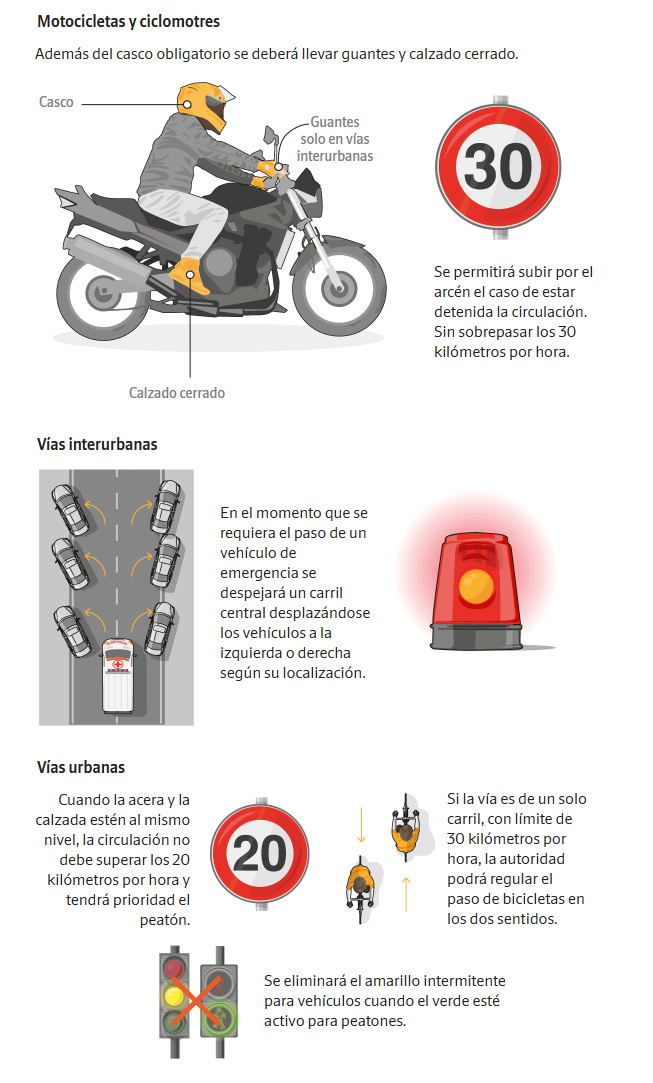
Use protective gloves on intercity roads.
Furthermore, both driver and passenger must wear closed-toe shoes that fully cover the foot , both on urban and interurban roads. BOE
Until the ministerial order determining the technical specifications for gloves is approved, protective gloves with the usual characteristics may continue to be used. BOE
Higher requirements for helmets
The reform stipulates that helmets used in the affected vehicles must comply with the corresponding homologation requirements, specifically UNECE Regulation R22 . BOE
However, there is a specific transitional period for mopeds : their drivers and passengers may continue to use certain certified helmets for one year from the date the reform comes into effect. BOE
Motorcycles will be allowed to drive on the shoulder during certain traffic jams.
Another of the most visible changes affects the movement of motorcycles when traffic jams occur.
Traffic on the right shoulder may be permitted in situations of congestion , provided that:
- In the sections expressly marked.
- Without exceeding the established speed, with a maximum expected of 30 km/h.
- Respecting the conditions established for this type of traffic.
The DGT (Spanish Directorate General of Traffic) includes this modification among the main new features of the new regulations.
Seat belts: exceptions are reduced
The new regulation also revises the exceptions related to seat belts.
Some professionals who were previously exempt in certain situations will have to use it after the new regulation comes into effect.
The amendment affects, among other things, professional activities related to transport and driver training, significantly reducing the existing exceptions. DGT
New emergency lane in case of traffic jam
Another important change particularly affects motorways and dual carriageways.
When traffic jams occur, vehicles must facilitate the creation of an emergency corridor or lane to allow passage for ambulances, fire trucks, police vehicles and other priority vehicles.
The regulation aims to expedite the arrival of emergency services when the road is congested. DGT
Changes in traffic due to snow
The regulations also introduce new rules when snow makes driving difficult.
In the situations stipulated by the Regulations, overtaking will be restricted and vehicles must give way to emergency services and vehicles responsible for road maintenance and snow removal. DGT
New security measures in cities
The reform incorporates for the first time a specific title dedicated to certain urban traffic regulations.
Among its new features is the legal recognition of so-called safe school routes , which will allow for the implementation of measures such as speed reduction, traffic calming, and restrictions on motor vehicles around schools. BOE
The regulations for certain traffic lights are also being modified to prevent, as a general rule, a flashing amber light for vehicles from coinciding with a steady green light for pedestrians . DGT
When does the new General Traffic Regulations come into force?
The main date that drivers and professionals should remember is:
1 2026 October.
Royal Decree 518/2026 expressly establishes that date for its entry into force. BOE
However, there are some transitional periods:
| Size | Application |
|---|---|
| New general regulations | 1 October 2026 |
| Minimum age of 15 years for VMP | 1 October 2026 |
| Helmet required on personal mobility vehicles (PMVs) | 1 October 2026 |
| Gloves for riding a motorcycle/moped on intercity roads | 1 October 2026 |
| Closed footwear for motorcycle/moped use | 1 October 2026 |
| VMP lighting also during the day | 1 October 2027 |
| End of the transition period for certain certified moped helmets | 1 October 2027 |
| Future technical specifications for gloves | Pending regulatory development |
The dates and transitional periods are taken from the Royal Decree published in the Official State Gazette (BOE) .
More protection for vulnerable road users
With this reform, the General Traffic Regulations incorporate new obligations for those who travel on scooters, bicycles, motorcycles or mopeds, but also new rules that directly affect cars, vans, trucks and other vehicles when they share the road with these users.
For professional drivers and transport-related businesses, understanding the changes will be especially important: the new distances, overtaking conditions, emergency lane and new traffic rules come into effect tomorrow, October 1, 2026.