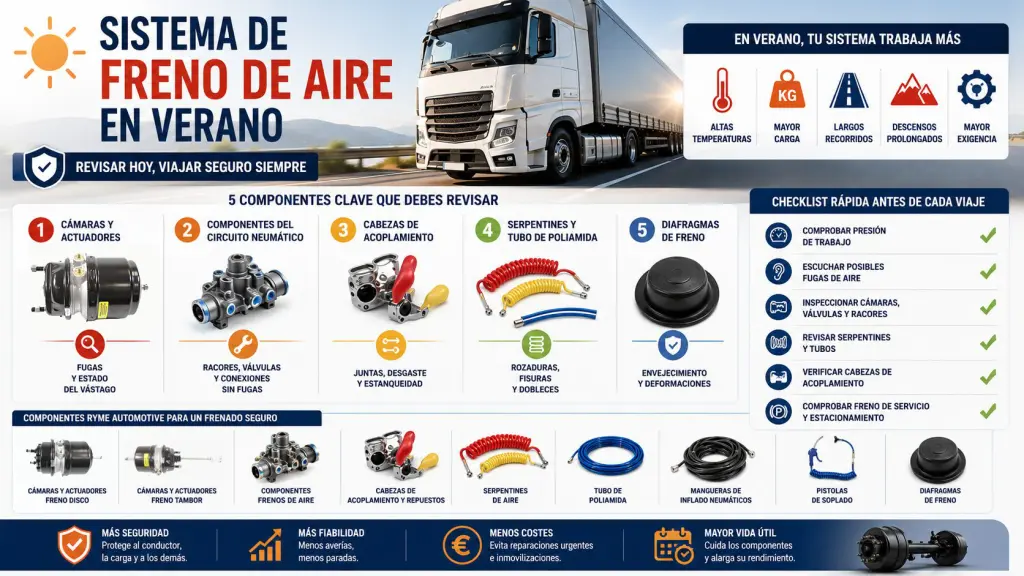
Why is it so important to check the pneumatic system before summer?
During the summer months, the air brake system operates under particularly demanding conditions. High temperatures, long journeys, maximum loads, and increased vehicle use all put extra stress on the pneumatic components.
A small air leak, a damaged diaphragm, or a faulty coupling can result in a loss of circuit pressure, reduced braking efficiency, and even vehicle immobilization.
What factors make the braking system work harder in summer?
High temperatures
Heat accelerates the aging of rubber, gaskets and diaphragms, in addition to increasing the working temperature of the entire system.
Greater load
The increased weight requires greater pressure and more effort during each braking.
Long journeys
More operating hours mean a greater number of work cycles for cameras, valves, and connections.
Prolonged descents
Continuous use of the system increases the risk of fatigue and premature wear.
The 5 components you should never stop checking
1. Brake chambers and actuators
What is your function?
They transform compressed air pressure into mechanical force to operate the braking system. Check:
- Air leaks.
- Stem condition.
- Corrosion.
- Actuator stroke.
- Anchors.
Risk of breakdown:
A faulty camera causes braking imbalances and loss of effectiveness.
2. Components of the pneumatic circuit
Includes:
- Valves.
- Fittings.
- Connectors.
- Splices.
- Pneumatic accessories.
What to check
- Absence of leaks.
- Correct pressure.
- Watertightness.
- Oxidation.
3. Coupling heads
They are the connection point between the tractor unit and the semi-trailer. Inspect:
- Together.
- Watertightness.
- Wear.
- Blows.
- Correct closure.
4. Air coils and polyamide tubing
They operate under continuous vibrations and constant movement between the tractor and trailer. Check:
- Abrasions.
- Cracks.
- Deformations.
- Strangulations.
- Connections.
5. Brake diaphragms
They are one of the wear components of the pneumatic system.
Over time and with exposure to high temperatures, they can harden, crack, or lose elasticity. Recommendation:
Replace them preventively during maintenance operations.
Quick checklist before hitting the road
- Check the system's working pressure.
- Listen for possible air leaks.
- Inspect cameras and actuators.
- Check polyamide coils and tubes.
- Check coupling heads.
- Check diaphragms.
- Check the correct operation of the service and parking brake.
- Check connections between tractor and trailer.
Ryme Automotive components for the air brake system
| Family | Application |
|---|---|
| Disc brake chambers and actuators | Activation of the braking system. |
| Drum brake chambers and actuators | Vehicles with drum brakes. |
| Air brake components | Complete pneumatic circuit. |
| Coupling heads | Tractor-trailer connection. |
| Air coils | Flexible air duct. |
| Polyamide tube | Pneumatic circuits. |
| Inflation hoses | Tire maintenance. |
| Blow guns | Cleaning and maintenance. |
| Brake diaphragms | Repair of pneumatic tubes. |
Preventative maintenance is always cheaper than repairs.
The air brake system is one of the most important safety features of a commercial vehicle. A pre-summer inspection helps reduce breakdowns, prevent downtime, improve driver safety, and extend the lifespan of all components in the pneumatic system.